Williams River Lodge Grand United Order of Oddfellows Banner
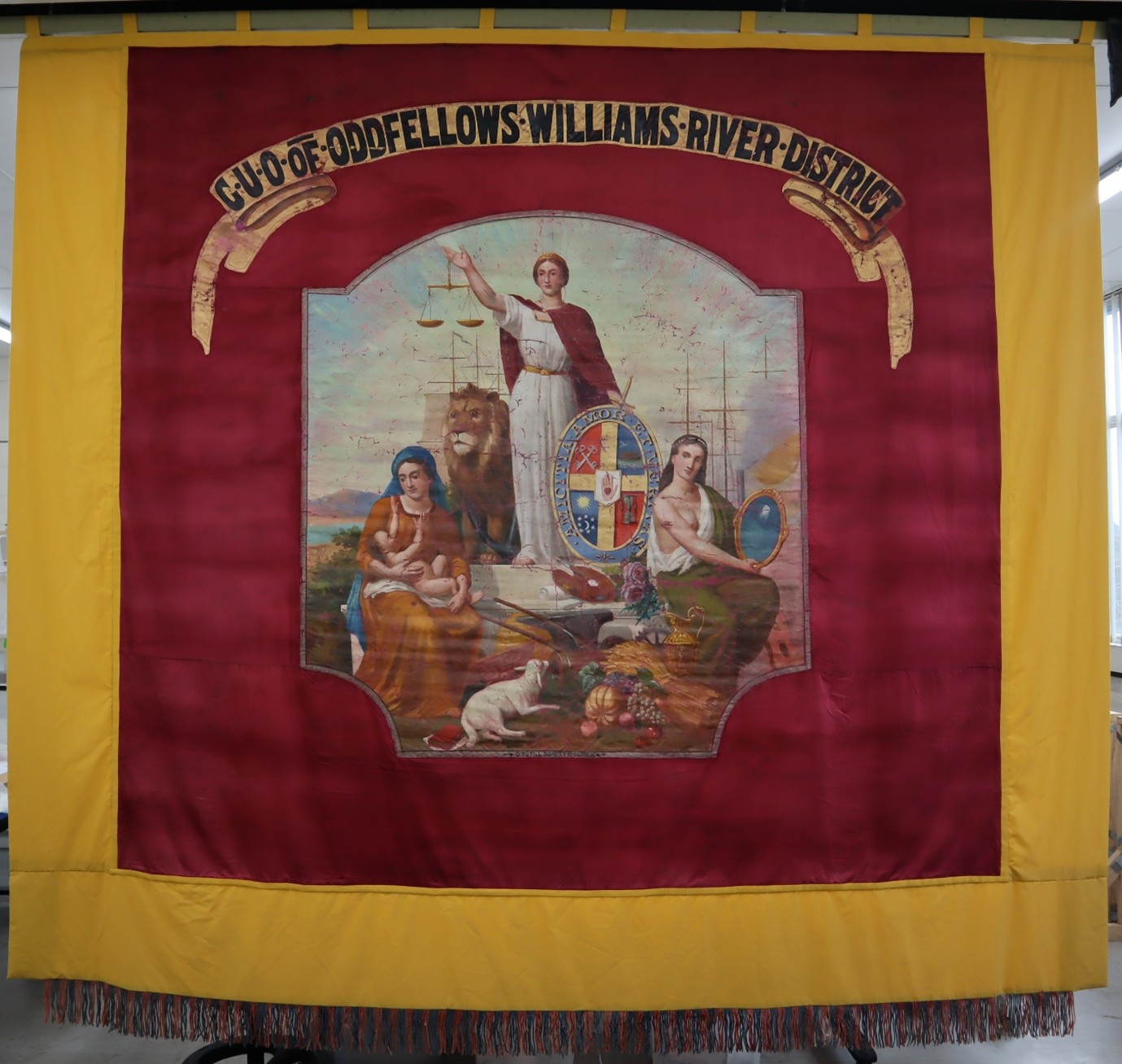
In 2009 a remarkable piece of 19th century Australian history emerged during renovations of the Stroud School of Arts Hall.
Discovered under the floorboards of the hall, this silk banner tells the story of one of Australia’s foundational community organisations. The banner was owned by the Williams River Lodge of the Grand United Order of Oddfellows (G.U.O.O.F). The Oddfellows were a friendly society set up to care and provide for their members and communities at a time before the establishment of health insurance and state welfare programs. The lodge was established in Dungog in 1874 and drew its membership from many of the small towns along the Williams River in the Hunter Region. Members of the Lodge made regular payments into a common fund used to pay sick leave and funeral expenses for members.
For the Williams River Oddfellows this banner was central to many of the Lodge’s public activities. It played an important role when attending the funeral of an Oddfellow. Members of the Lodge would march from the grave with the banner held at the head of the procession to the deceased’s home where money would be handed over to the bereaved family. Its use was not limited to these sombre occasions and would have featured at all manner of social events including sporting competitions, feasts, and brass band performances.
The banner and its use are steeped in symbolism that reflect the core values of the Oddfellows. Such a banner would have cost more than an average working man’s annual salary to purchase. The use of silk, hand painted illustrations and gilded decorative elements imply the shared wealth and financial security enjoyed by G.U.O.O.F members. The size of the banner meant it could only be carried in parades and processions through cooperative effort, reflecting the spirit or combined support and comradeship central to G.U.O.O.F beliefs. The paintings on either side of the banner are also filled with symbolic meaning. The three figures represent love, truth and friendship.
The Williams River lodge was active until at least 1949 - when it had 649 members - but little is recorded of their activities in local newspapers beyond this date. At some point the banner moved from Dungog to the Stroud School of Arts Hall and stored beneath the hall’s floorboards. It was rediscovered when the building was under repair in 2009. Great Lakes Council offered the banner as a donation to the Newcastle Museum collection.
The banner was in poor condition when it was received by Newcastle Museum. Museum collection staff worked with International Conservation Services (ICS) to develop a plan to stabilise this significant piece of local history and return it to display condition.
With the aid of a grant from the Copland Foundation, Newcastle Museum was able to commission the team at ICS to proceed with this work. Conservators surface cleaned the banner, repaired tears, and infilled parts of the images where major paint loss had occurred. They replaced the yellow boarder fabric and hanging system , as these had received irretrievable damage from red dye and displayed signs of mould. This work was successfully completed stabilising the banner and preserving it for generations to come.
The banner is now on permanent display in the museum’s ‘A Newcastle Story’ exhibition.
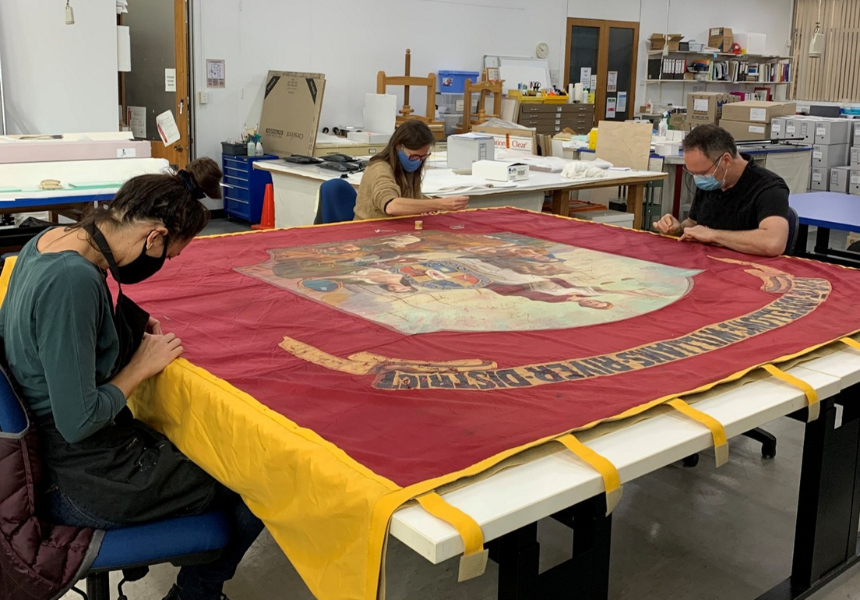
Members of the International Conservation Services team performing conservation work on the banner.